
For a while now, a certain kind of brand aesthetic has been in demand, and it shows no sign of losing momentum. Quieter palettes, more white space, a tone that feels considered rather than loud. This is the kind of elegance most founders want for their brand. From what I’ve seen working closely with brands, I think I understand why this particular look gets chased so often. It feels like the easiest version of elegance to execute. A clean background, smaller text, a minimal layout, and the assumption is that this alone adds up to an elegant brand. It doesn’t. What gets left out Elegance, the kind that holds up across a feed, a website, a year of content, rarely comes from adding the right visual touches. It comes from deciding, with precision, what gets left out. A brand trying to speak to everyone ends up saying nothing clearly to anyone. The brands that feel quietly confident are usually the ones that removed the most, not the ones that found the right aesthetic formula. Present versus defined There is a difference between a brand that is present everywhere and a brand that is defined. Presence means showing up, on Instagram, on a website, in a pitch deck. Definition means that every one of those appearances reinforces the same thing. Most founders have presence. Few have built definition, and the two are easy to confuse from the inside, especially when the visuals already look clean. Why restraint is harder than expansion Restraint is harder than expansion. Adding a new service, a new content pillar, a new visual element requires no real decision, it is simply additive. Removing something requires certainty about what matters most, and most brands never built that certainty in the first place. The aesthetic feels unreachable not because of a lack of taste, but because nothing was ever decided clearly enough to know what to leave out. This shows up in the numbers, not just the feeling. Brands that maintain consistency across every touchpoint see revenue increases of 23% to 33%, according to two separate studies from Lucidpress surveying over 600 brand management professionals. Consistency is not a stylistic preference. It is a measurable structural advantage, and it is only possible once there is something clear to be consistent about. Elegance is rarely the result of doing less. It is the result of deciding, precisely, what matters most. The structure beneath the precision That kind of precision does not live in a moodboard. It lives in a structure, a clear positioning, a defined set of brand assets, a logic that determines what belongs and what doesn’t before a single visual decision gets made. Without that structure, restraint becomes guesswork, removing things at random and hoping the result feels intentional. With it, every choice, visual or otherwise, has a reason behind it. This is the part most founders skip, because it is invisible. They go straight to the look, because the look is what they can see and adjust. But the brands that sustain that quiet, elegant quality over time are the ones that built the structure first, then let the visual identity follow from it. Elegance is not copied from a moodboard. It is built by deciding, with that same precision, what a brand actually is, what it stands for, what it will never say, before deciding how it looks. The visual is not the starting point. It is where that clarity finally becomes visible. If you are still figuring out where your brand’s structure actually stands, the Brand Foundation Framework was built to make that visible.

Visibility is what happens when you show up. A post performs. A story gets views. Someone shares your work. The people already in your orbit see it. Visibility is active — it exists when you are producing, and it contracts when you are not. Discoverability is different. It is what happens when someone who does not know you yet finds you — through search, through a recommendation that exists independently of your activity, through a piece of content that continues working after you published it. Discoverability is structural. It does not depend on the founder showing up today. The cost of visibility without structure Most brands invest almost entirely in visibility. They produce content for the audience they already have. The feed is active. The stories are consistent. The engagement is real. And the list of people who know the brand barely grows — because the brand is not structured to reach anyone outside the existing circle. The cost of this is easy to misread. The brand looks like it is working. The metrics confirm presence. The posts land. But the enquiries come from the same sources. The reach does not expand. Growth depends on the founder’s output rather than on a structure that operates when the founder is not producing. This is not a small distinction. It is the difference between a brand that requires constant energy to maintain visibility and a brand that grows independently of daily activity. One is a treadmill. The other is compound. What visibility alone looks like A brand that is only visible to the people already following it is not discoverable. It is a private body of work — well-made, consistently maintained, and structurally invisible to the people who should be finding it. The feed looks intentional. The aesthetics are coherent. The founder shows up reliably. And none of that moves the brand closer to the people outside the immediate circle who would actually hire them, actually buy from them, actually care about the work. The person scrolling Instagram and seeing the posts — that is visibility. The founder searching for exactly what you do and finding you without ever being introduced to you — that is discoverability. Most brands optimize for one and wonder why the other does not happen. The structural difference Discoverability requires different decisions. It requires content that is built for search rather than only for engagement. It requires an entry point — a lead magnet, a diagnostic, a resource — that captures interest before it dissipates. It requires a path from first contact to conversion that does not depend on the founder being present at the moment someone discovers the brand. These are not content decisions. They are structural ones. And they do not resolve through posting more or showing up more consistently. They resolve through building the architecture that makes the brand findable — and that continues working independently of the founder’s daily activity. A founder producing four posts a week without discoverability structure is still invisible to everyone outside the feed. A founder producing one post a week with discoverability architecture is being found continuously — by search, by referral, by content that works after publication. The invisibility cost The irony is that discoverability is easier to build than most founders think. It does not require more content. It requires different content. Content optimized for being found, not just being seen. Content that solves a problem someone is searching for. Content that creates a path from search to signup to sale. Without it, you have visibility. You have presence. You have proof that the brand exists and produces. What you do not have is a structure that reaches beyond your circle. What you do not have is growth that does not depend on your daily effort. Presence without discoverability is a private body of work. If you want to understand what that structural work involves — where your brand reaches and where it remains invisible, what needs to change in your content architecture, what entry points are missing — there is a framework designed to map exactly that. It shows you where visibility ends and where discoverability needs to begin. Because growth that scales does not come from showing up more. It comes from being structured to be found.

A social media kit resolves the execution layer of a brand — the visual consistency, the aesthetic coherence, the time spent on design decisions that should already be settled. What it does not resolve is the layer underneath. The positioning. The communication logic. The criteria that determine what you say, to whom, and why each piece of content exists beyond filling the feed. When execution is the only answer Most founders who invest in execution tools are ready for the next conversation. They have the surface. They are beginning to feel the limits of what surface alone can do. A kit of templates makes your feed look intentional. It does not make your communication intentional. The visual consistency arrives quickly. What does not arrive is the clarity about what you are actually saying. Two founders can use the same templates and communicate completely different things — one with authority, one with noise. The difference is not the design. It is what sits underneath. This is not a criticism. It is an observation about what happens when execution moves faster than positioning. The templates are precise. The message is not. So the brand communicates aesthetics rather than authority. The precision that matters When those foundations are defined — when you know what you are communicating, to whom, and why — execution becomes something different. The templates stop being decoration. Every post carries criteria. Every design choice reinforces something intentional rather than just looking good. A founder with defined positioning uses templates differently than a founder without clarity. For one, the visual consistency expresses a strategy. For the other, it expresses that someone hired a designer. Both outputs look professional. Only one looks like a brand. The templates do not create that difference. The thinking underneath creates it. The positioning creates it. The communication logic creates it. The templates just make it visible consistently. Where execution actually runs into limits A social media kit accelerates what is already decided. When nothing is decided — when you have not yet defined what your positioning is, what you want to communicate, what makes you different, or who you are actually talking to — no template solves that. No amount of visual polish solves that. This is why brands with beautiful feeds still struggle to convert. This is why consistency is not the same as authority. A brand that publishes consistently without clarity is just more visible noise. The consistency makes it more visible. It does not make it matter. The work that moves you forward is not more execution. It is clarity. It is defining what sits underneath the template so that when the template goes live, it communicates something specific instead of just filling the feed. A kit of templates resolves the execution layer. It does not resolve the layer that determines what you communicate. If you want to understand what that foundational work involves — how to map where your positioning is clear and where it fragments — there is a framework designed to diagnose exactly that. It maps the gaps. It shows you what needs to be defined first. Because every execution decision that follows becomes clear once you know what you are actually building.
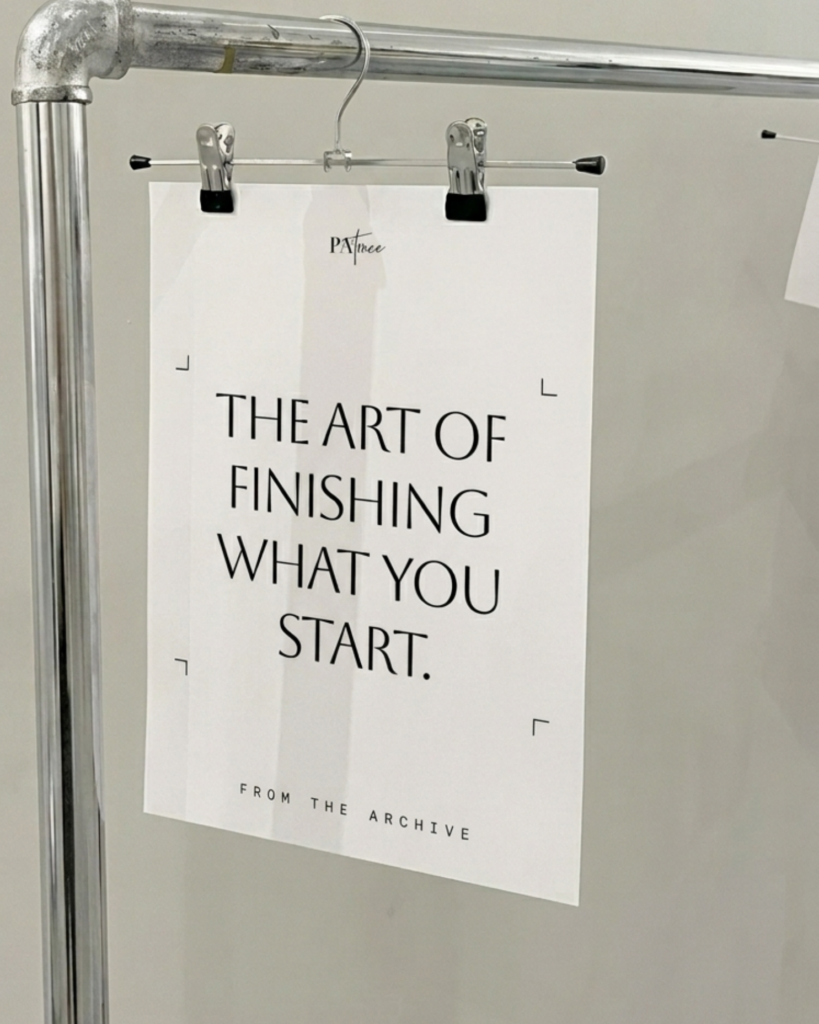
You decide to finally do it properly. Maybe it’s starting a blog, launching a new content direction, or putting together a campaign you’ve been thinking about for weeks. You open your laptop, you open Notion, you write it down on your to-do list. At the beginning, it feels simple, you know. You more or less know what you want to say, how you want it to feel, what direction it should go in. You start writing, sketching things out, putting pieces together. It moves quickly. Then you reach a point where it’s no longer the beginning. The piece exists, but it’s not finished. And suddenly, there are too many ways it could go. When everything starts to open The title could be stronger. The angle could be sharper, or maybe softer. You could turn it into a carousel, or maybe it works better as a blog post. Or maybe it should go on Pinterest instead. You start thinking about how it fits with everything else you’ve done. You make a few changes. Then a few more. You rewrite something, adjust the format, rethink the idea. Nothing feels completely wrong, but nothing feels fully locked either. The work doesn’t stop because it’s hard. It stops because too many directions remain possible. At that point, finishing becomes less likely. Not because you don’t want to finish it, but because each step requires deciding again what this is actually supposed to be. → Explore the system behind brand clarity Why it keeps happening This is usually the point where it turns into something else. You start thinking you’re procrastinating. That you lack discipline. That you’re overthinking. It can even feel like a form of self-sabotage. You tell yourself you should just finish it, push through, stop making it complicated. But every time you try to continue, you’re back in the same place, deciding again what this piece is supposed to be. That’s where the frustration comes from. It’s not just that the work is unfinished. It’s that it feels like it should be easy, and it isn’t. What’s actually happening is simpler. Too much has been left open. The format, the tone, the role of the piece — none of it has been defined enough to hold the work in place. So instead of executing, you’re navigating possibilities. And that’s what slows everything down. Finishing becomes possible when fewer decisions are left to be made while you’re in the middle of the work. When enough has already been defined, the process stops expanding and starts moving.

Perceived value is shaped through restraint, precision, and consistency in execution. It increases when brands control what they say, how they structure it, and what they choose to leave out.

Posting daily often creates pressure that lowers content quality. Reducing frequency and improving systems leads to stronger execution and more efficient content creation.

Brands begin to lose direction when each new post is shaped by the last one instead of a fixed content system. This shift becomes visible through subtle changes in tone, format, and visual decisions over time.

You publish consistently. The visuals feel aligned, the tone is considered, and the message seems clear from your side. Each piece of content feels intentional when you create it. And still, something doesn’t land the way it should. People engage, but not always with what you thought you were saying. They respond to certain parts, ignore others, and over time, a version of your brand starts to take shape that feels slightly off. How meaning gets constructed without you noticing Every decision you make contributes to how your brand is understood. What you choose to show, what you repeat, what you simplify, what you leave out. None of these feel decisive on their own, but together they create a pattern. That pattern is what people read. When there is no clearly defined structure behind those decisions, the pattern still forms. It just forms on its own terms. Content becomes a series of responses instead of a system that accumulates. Over time, that accumulation builds a version of the brand that feels coherent enough to be recognised, even if it was never fully defined. People don’t interpret your intention. They interpret your repetition. Where the misalignment actually comes from The issue doesn’t sit in individual pieces of content. Each one can make sense in isolation. The problem appears in how those pieces relate to each other over time. A slight shift in tone here, a broader message there, a visual that leans in a different direction. None of it feels significant in the moment. All of it contributes to a gradual drift in how the brand is perceived. At some point, the brand starts to feel familiar, but not precise. Recognisable, but not clearly positioned. The audience understands something, just not exactly what you intended to build. This is where friction begins to show up in subtle ways. You need to explain more. You repeat ideas with small variations. You adjust the message depending on context, trying to recover clarity that was never fully stabilised. → Explore the system behind brand clarity What changes when structure is defined When the structure behind your brand is properly established, decisions begin to align without needing constant reinterpretation. There is a reference point that holds across contexts. The pattern becomes more contained. What you communicate starts reinforcing itself instead of drifting. Interpretation still exists, but it becomes narrower, more accurate, and more stable over time. The audience starts to recognise the same idea from different angles, instead of assembling a different version each time. And gradually, the distance between what you mean and what is understood begins to close.

There’s a pattern that becomes visible over time in brands that appear active, engaged, and constantly in motion. Content evolves, formats shift, and direction adjusts in small increments. Each decision feels justified in the moment, shaped by context, timing, or a need to respond. On the surface, it reads as responsiveness. Internally, it creates something less stable. The process begins to lose continuity. What gets created is no longer anchored in a defined structure. Each piece becomes an isolated response rather than part of a system that accumulates. The work continues, though it stops building on itself. Over time, this introduces a subtle form of fragmentation. The tone moves slightly. The visual language adapts. The focus shifts depending on what feels most relevant at that point. None of these changes disrupt the brand immediately, though they begin to dilute its ability to hold a consistent position. Recognition weakens gradually. Decisions require more effort because there is no fixed reference to return to. Each output demands reconsideration. What could operate as a repeatable process remains dependent on interpretation. This is where weight begins to appear in the work. A brand that keeps redefining itself in public eventually loses the ability to be recognised at all. At this point, the issue sits beneath content production, in the absence of a structure that allows decisions to stabilise and carry forward. Without that structure, nothing compounds. The work resets each time, requiring the same level of attention, energy, and decision-making as before. What could have been systematised remains fluid, and what remains fluid cannot sustain consistency over time. → Explore the system behind consistent content When a clear foundation is established, something shifts in how the brand operates. Decisions begin to align without needing to be constantly revisited. Patterns emerge naturally. The work becomes more contained, more precise, and more consistent in how it presents itself. Over time, this creates a different kind of movement. Less visible variation, with stronger accumulation.