Filed In
- Execution
The Art of Finishing What You Start
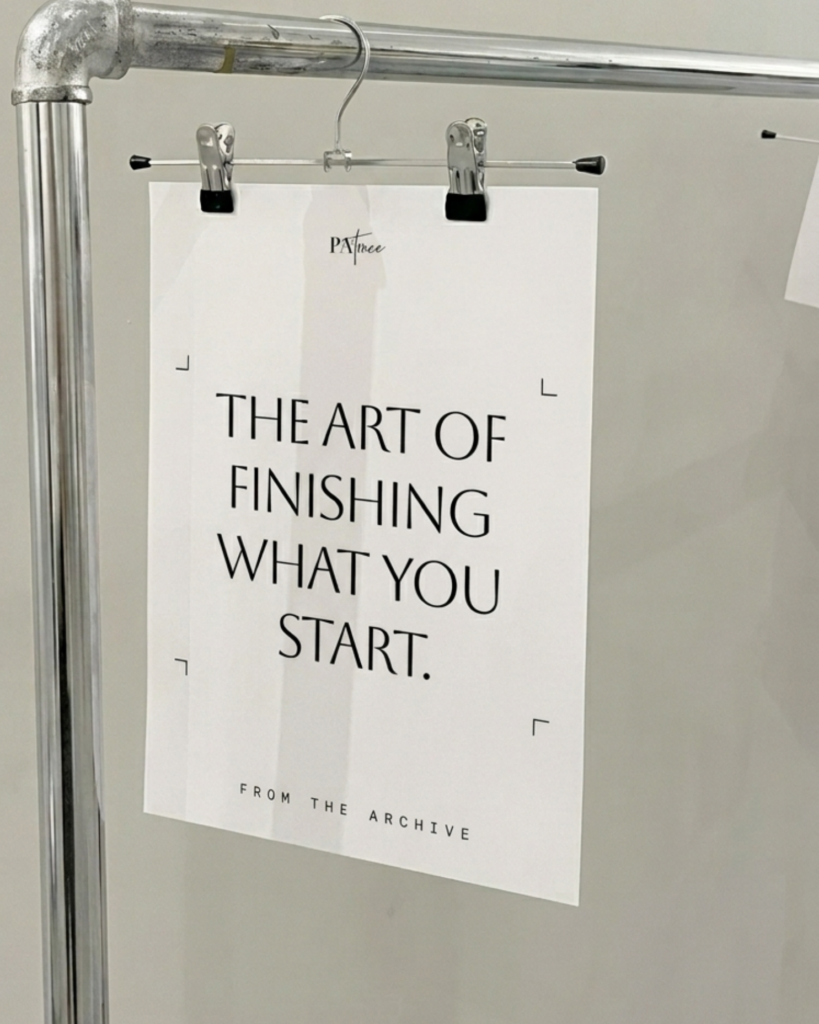
The Art of Finishing What You Start
You decide to finally do it properly. Maybe it’s starting a blog, launching a new content direction, or putting together a campaign you’ve been thinking about for weeks. You open your laptop, you open Notion, you write it down on your to-do list.
At the beginning, it feels simple, you know. You more or less know what you want to say, how you want it to feel, what direction it should go in. You start writing, sketching things out, putting pieces together. It moves quickly.
Then you reach a point where it’s no longer the beginning. The piece exists, but it’s not finished. And suddenly, there are too many ways it could go.
When everything starts to open
The title could be stronger. The angle could be sharper, or maybe softer. You could turn it into a carousel, or maybe it works better as a blog post. Or maybe it should go on Pinterest instead. You start thinking about how it fits with everything else you’ve done.
You make a few changes. Then a few more. You rewrite something, adjust the format, rethink the idea. Nothing feels completely wrong, but nothing feels fully locked either.
The work doesn’t stop because it’s hard. It stops because too many directions remain possible.
At that point, finishing becomes less likely. Not because you don’t want to finish it, but because each step requires deciding again what this is actually supposed to be.
→ Explore the system behind brand clarity
Why it keeps happening
This is usually the point where it turns into something else. You start thinking you’re procrastinating. That you lack discipline. That you’re overthinking. It can even feel like a form of self-sabotage.
You tell yourself you should just finish it, push through, stop making it complicated. But every time you try to continue, you’re back in the same place, deciding again what this piece is supposed to be.
That’s where the frustration comes from. It’s not just that the work is unfinished. It’s that it feels like it should be easy, and it isn’t.
What’s actually happening is simpler. Too much has been left open. The format, the tone, the role of the piece — none of it has been defined enough to hold the work in place.
So instead of executing, you’re navigating possibilities. And that’s what slows everything down.
Finishing becomes possible when fewer decisions are left to be made while you’re in the middle of the work. When enough has already been defined, the process stops expanding and starts moving.
A structured reflection developed through The Foundry System™




Search by topic, idea, or concept.
Cookies help us understand what works, what doesn’t, and how to improve this experience with precision. You remain in control — always.

Layer I — Clarity
Layer II — Strategy
Operated through The Foundry System™ — a modular brand operating system designed to bring structure to strategic growth.
The Foundry System™




New entries are developed inside The Archive, built around structure, decisions, and the patterns that shape how brands evolve over time. Subscribe to receive them.